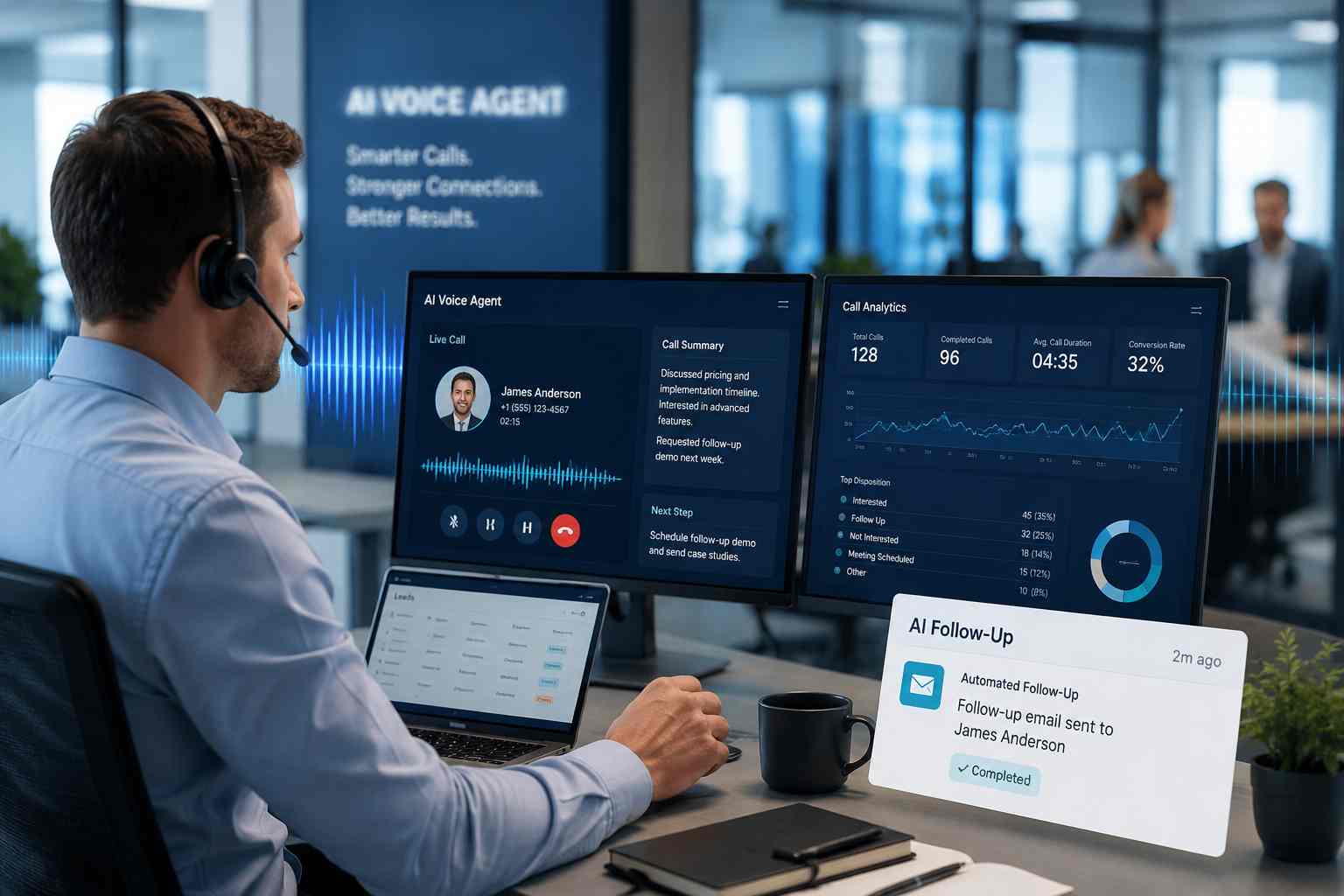
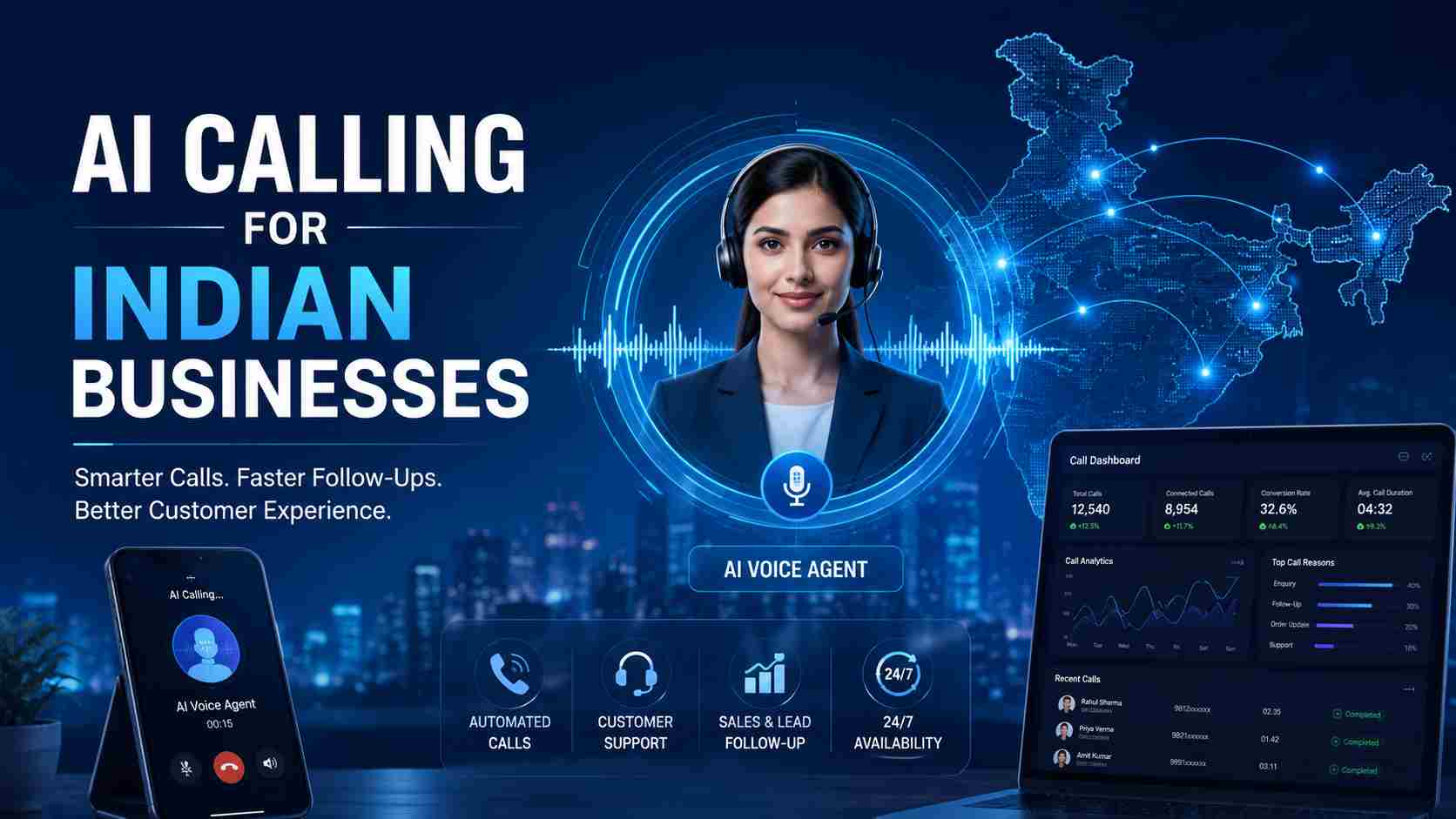
AI calling for businesses is becoming a practical way for Indian companies to manage customer conversations, sales follow-ups, appointment calls, lead qualification, and routine support without depending entirely on manual telecalling. For businesses in Delhi, Delhi NCR, Gurugram, Faridabad, Noida, and other growing markets, AI voice technology can help teams respond faster, handle repetitive conversations, and create a more consistent calling process.
An AI calling system typically uses an AI voice agent to understand what a customer says, respond according to a defined conversation flow, collect information, and trigger the next business action. Depending on the implementation, it can support inbound calls, outbound calls, lead follow-ups, reminders, appointment confirmations, customer support, and sales qualification.
The technology does not mean that every human calling activity should disappear. In many businesses, the stronger approach is a combination of AI call automation and human involvement. AI can handle repetitive and predictable conversations while employees focus on negotiations, complex questions, sensitive cases, and decisions that require human judgment.
For Indian businesses dealing with high enquiry volumes, delayed follow-ups, repetitive calls, or customer support pressure, this distinction matters. The question is no longer simply whether AI can make a call. The more useful question is where AI calling can create measurable operational value and where human interaction should remain central.
What Does AI Calling for Businesses Actually Mean?
AI calling for businesses refers to the use of artificial intelligence and voice technology to conduct, receive, understand, and manage business phone conversations. An AI voice agent can follow business-defined conversation flows, respond to customer questions, collect information, qualify leads, schedule actions, and transfer conversations to human employees when required.
Unlike a basic recorded IVR, an AI-powered calling system can be designed to respond dynamically to what a caller says. Instead of forcing every customer through the same numbered menu, the system can interpret the conversation and continue according to the customer's intent.
For example, a real estate company may receive a large number of enquiries about properties. An AI voice agent can ask whether the caller is looking to buy or rent, understand the preferred location, collect a budget range, ask about property requirements, and pass qualified information to a sales representative.
A healthcare business may use AI calling differently. The system could help with appointment confirmations, reminders, basic scheduling questions, or follow-ups while routing sensitive or complex medical discussions to appropriate staff.
The underlying principle is simple: AI handles structured conversations at scale, while humans handle situations that require judgment, empathy, expertise, or negotiation.
How Does an AI Voice Agent Work During a Business Call?
An AI voice agent generally operates through several connected stages:
Call initiation or reception
The system either receives an incoming call or starts an outbound call according to the business workflow.Speech recognition
The customer's spoken words are converted into information that the AI system can interpret.Intent understanding
The system determines what the caller is trying to achieve, such as requesting information, confirming an appointment, asking about a service, or responding to a sales enquiry.Conversation response
The AI generates an appropriate response based on the business's instructions, available information, and conversation context.Information collection
The system can collect relevant details such as name, requirement, location, preferred time, or enquiry category.Action or escalation
Depending on the conversation, the system can complete a defined action, update a connected workflow, schedule a follow-up, or transfer the call to a human employee.Call record and follow-up
Business teams can use the captured information for subsequent sales, support, or customer-service activities, depending on the system configuration.
The exact capabilities depend on the AI calling software, integrations, voice technology, business workflow, and implementation quality.
Why Are Indian Businesses Adopting AI Calling?
Indian businesses often operate across large customer bases and multiple communication channels. Sales teams may receive enquiries throughout the day, while customer support teams may spend significant time answering similar questions.
AI calling can address some of these operational challenges by introducing automation into the calling process.
A company may have hundreds of leads in a CRM but limited sales staff. A manual team has to prioritise which leads to call first, make the calls, record the outcomes, and schedule follow-ups. When the process becomes repetitive, important leads can remain untouched for too long.
AI call automation can support the first layer of this workflow.
For example:
New enquiry → automated call → requirement captured → lead qualified → sales team notified → human follow-up
This does not guarantee a sale. It creates a more structured process around the opportunity.
For growing businesses, that process can be more valuable than simply increasing the number of calls.
How Can AI Calling Improve Lead Follow-Up?
AI calling can make lead follow-up more systematic by automating defined calling workflows.
Consider a business that receives online enquiries during the day. Without automation, a salesperson may have to review the enquiries, identify suitable leads, make calls, record responses, and decide when to call again.
A well-designed AI calling workflow can take over repetitive parts of this process.
For example, a lead may receive an automated call after submitting an enquiry. The AI voice agent can confirm the requirement, ask qualifying questions, identify whether the lead is ready to speak with a salesperson, and record the outcome.
The sales team can then focus on conversations where human involvement adds greater value.
The main benefit is not simply "more calls." It is better organisation of the calling process.
What Types of Calls Can AI Calling Handle?
AI calling can be applied to several business communication workflows, including:
Lead qualification
New enquiry follow-up
Appointment confirmation
Appointment reminders
Service reminders
Customer feedback calls
Order-related communication
Basic customer support
Sales qualification
Missed-call follow-up
Outbound campaign workflows
Inbound enquiry handling
Information collection
Renewal reminders
Follow-up scheduling
The suitability of each use case depends on the business process and the complexity of the conversation.
A highly structured appointment confirmation may be a strong automation candidate. A sensitive complaint requiring negotiation may need immediate human involvement.
Can AI Calling Replace Human Telecallers?
AI calling should not automatically be viewed as a complete replacement for human telecalling.
The better question is which parts of the calling process require human judgment.
Traditional telecalling remains valuable when a conversation involves:
Complex negotiation
Emotional customer situations
High-value sales discussions
Detailed technical explanations
Relationship management
Sensitive financial decisions
Complex complaints
Strategic account management
AI can be useful for the repetitive layer surrounding these activities.
For example, instead of having sales representatives spend hours confirming appointments, checking basic requirements, or repeatedly asking qualification questions, those tasks can be automated. The representatives can then spend more time on higher-value conversations.
This creates a human + AI calling model rather than an AI-only model.
How Does AI Calling Support Sales Teams?
Sales teams frequently lose time on repetitive activities surrounding a sale rather than the actual sales conversation.
AI sales calling can support several stages of the sales funnel.
Lead Qualification
An AI voice agent can ask predefined qualification questions and collect basic information.
For a property enquiry, this could include:
Preferred location
Buying or renting requirement
Approximate budget
Property type
Expected timeline
For an education business, the questions may involve:
Course interest
Education level
Preferred programme
Admission timeline
Preferred communication method
The collected information can help sales teams understand which enquiries need immediate human attention.
Follow-Up
A lead that does not answer the first call may require another attempt.
A structured AI calling workflow can manage defined follow-up schedules instead of relying entirely on employees to remember each lead.
Appointment Scheduling
AI calling can help customers confirm or reschedule appointments when the process is straightforward.
Sales Handover
When a conversation reaches a point where human expertise is required, the workflow can transfer or route the customer to a suitable employee.
The quality of this handover is critical. A human representative should receive useful context rather than starting the conversation from zero.
How Can AI Calling Help Customer Support?
Customer support teams often deal with repeated questions.
Customers may ask about:
Business hours
Appointment status
Service availability
Order information
Basic product information
Delivery-related updates
Booking confirmation
Routine service requests
When the answers are clear and the workflow is structured, AI customer support can manage some of these interactions.
The purpose is not to make every support conversation automated. It is to reduce unnecessary pressure on human teams.
A useful implementation should also recognise when it cannot answer a question confidently. A system that keeps repeating irrelevant responses can create frustration instead of improving customer experience.
Human escalation should therefore be treated as a core feature rather than an afterthought.
What Business Problems Can AI Call Automation Solve?
AI call automation can address several common operational problems.
Delayed response: New leads may not receive a call quickly enough.
Repetitive work: Employees may spend large portions of their day asking the same basic questions.
Inconsistent follow-up: Different employees may follow different calling schedules.
Limited operational capacity: A small team may struggle when enquiry volume increases.
Missed calls: Businesses may lose opportunities when calls arrive outside normal staffing availability.
Poor information capture: Call outcomes may not always be recorded consistently.
Support overload: Human agents may spend time answering questions that follow predictable patterns.
AI does not automatically solve these problems. The business must first design a clear workflow and define what the system should and should not do.
How Can AI Calling Help Businesses in Delhi NCR?
Delhi NCR includes businesses across real estate, healthcare, education, professional services, e-commerce, logistics, hospitality, financial services, and other industries.
Many of these businesses depend heavily on phone-based communication.
A real estate company in Delhi may need to qualify property enquiries. A Gurugram service company may need to manage appointment requests. A Faridabad business may need to follow up with customers after an online enquiry. A Noida-based company may need to manage inbound product questions.
The use case changes by business, but the underlying requirement remains similar: customers expect timely communication, while employees have limited time.
AI calling solutions in Delhi NCR can therefore be useful when the business has a clearly defined communication workflow.
Where Can AI Calling Be Useful in Real Estate?
Real estate is one of the industries where structured calling workflows can be particularly useful.
Property businesses often receive enquiries from websites, advertising campaigns, portals, social media, and other sources.
An AI voice agent can potentially help with:
Initial enquiry follow-up
Buyer or tenant qualification
Location preference
Budget collection
Property requirement collection
Site-visit confirmation
Appointment reminders
Lead reactivation
The system can then pass qualified information to the sales team.
The important distinction is between qualification and negotiation. Qualification can often follow structured questions. Negotiation about price, terms, or complex property concerns is generally better handled by experienced sales professionals.
Where Can AI Calling Be Useful in Healthcare?
Healthcare requires greater care because conversations can involve sensitive information.
AI calling may be suitable for operational workflows such as:
Appointment confirmations
Appointment reminders
Scheduling requests
Basic service information
Follow-up reminders
Patient feedback workflows
Sensitive medical conversations should be handled according to the organisation's policies, applicable requirements, and appropriate human escalation procedures.
An AI system should not be presented as a replacement for qualified medical professionals.
Where Can AI Calling Be Useful in Education?
Education companies, coaching centres, training organisations, and institutions often receive repeated enquiries.
AI calling can help with:
Course enquiry follow-up
Basic programme information
Counselling appointment scheduling
Admission enquiry qualification
Reminder calls
Follow-up on incomplete enquiries
A human counsellor can then handle questions involving career decisions, course selection, detailed academic guidance, or other complex matters.
Where Can AI Calling Be Useful in E-Commerce?
E-commerce companies typically manage high volumes of customer communication.
Depending on the workflow, AI calling may support:
Order-related calls
Delivery communication
Customer feedback
Return-related information
Service reminders
Basic customer queries
The exact workflow should depend on the information available to the AI system and the company's customer service process.
Where Can AI Calling Be Useful in Financial Services?
Financial services require particularly careful implementation because customer conversations can involve sensitive information and regulated activities.
AI may support defined administrative workflows, reminders, basic information requests, or routing.
Businesses should avoid assuming that an AI voice agent can independently provide regulated financial advice or make decisions that require authorised professionals.
Where Can AI Calling Be Useful in Hospitality and Logistics?
Hospitality businesses can use structured voice workflows for bookings, confirmations, reminders, and routine enquiries.
Logistics companies may use calling automation for defined communication processes around deliveries, scheduling, confirmations, and status-related workflows.
Again, the value comes from choosing a narrow, repeatable process rather than attempting to automate every conversation at once.
What Should a Business Automate First?
The strongest starting point is usually a repetitive, measurable, low-complexity workflow.
A business can evaluate potential processes using four questions:
Does the conversation happen frequently?
Are most questions predictable?
Can the desired outcome be clearly defined?
Is there an easy way to transfer complex cases to a human?
If the answer is yes to most of these questions, the process may be suitable for automation.
A business does not need to automate its entire call centre on day one.
Starting with one workflow makes testing easier and allows the organisation to identify problems before expanding.
Why Does Response Speed Matter in Sales?
A lead represents a potential business opportunity only while interest remains active.
When a person submits an enquiry, there is usually a reason behind the action. The customer may be comparing providers, looking for a property, searching for a service, or trying to solve an immediate problem.
If the business waits too long to respond, the customer may contact another provider.
AI-powered calling can help businesses build a faster first-response workflow.
For example:
Website enquiry → automated acknowledgement → AI qualification call → lead classification → human sales follow-up
This process can reduce dependence on manual lead distribution.
However, faster calling is not automatically better customer experience. The conversation must remain relevant, respectful, and appropriately timed.
Can AI Calling Work Outside Traditional Business Hours?
AI calling systems can be designed to support workflows beyond the operating hours of a traditional call centre, depending on the provider, infrastructure, and use case.
This can be useful for businesses that receive enquiries outside normal working hours.
For example, an enquiry arriving late in the evening could enter an automated workflow that provides basic information, captures the customer's requirement, and schedules human follow-up for the next working period.
This creates a bridge between the customer's timing and the employee's working schedule.
However, "24/7 availability" should not be interpreted as unlimited permission to make promotional calls at any time. Businesses must consider telecom regulations, consent, customer preferences, and applicable communication rules.
TRAI's current guidance states that commercial communications are subject to regulatory requirements, including sender registration, headers, content templates, and consent processes where applicable.
What Is the Difference Between an AI Call Centre and an IVR?
A traditional IVR generally provides predefined menu options.
For example:
Press 1 for Sales
Press 2 for Support
Press 3 for Accounts
An AI call centre can provide a more conversational experience.
Instead of requiring a customer to identify the correct menu, the customer can explain the reason for calling in natural language.
The AI system can then attempt to understand the intent and route the conversation accordingly.
However, AI does not eliminate the need for structured design. The organisation still needs to define supported intents, business rules, escalation paths, data access, and limits.
How Much Does AI Calling Software Cost for an Indian Business?
There is no single price that applies to every AI calling implementation.
The total cost can depend on factors such as:
Number of calls
Call duration
Inbound versus outbound usage
Voice technology
Language requirements
CRM integration
Call recording
Analytics
Workflow complexity
Human transfer requirements
Infrastructure
Support requirements
Compliance requirements
A small business with one basic workflow may have very different requirements from a large organisation operating multiple campaigns and integrating several systems.
Businesses should therefore compare solutions based on total operational value, not only the per-minute or monthly software price.
A lower-priced system may become expensive if it requires significant manual work, poor integrations, or frequent human intervention.
What Should Businesses Measure After Implementation?
A business should define measurable indicators before launching an AI calling workflow.
Useful metrics may include:
Contact rate
Successful connection rate
Lead qualification rate
Appointment booking rate
Follow-up completion rate
Human transfer rate
Call abandonment rate
Customer satisfaction
Average handling time
Cost per completed interaction
Conversion rate after human handover
The exact metrics should reflect the business objective.
If the goal is appointment confirmation, appointment completion may matter more than the total number of calls.
If the goal is lead qualification, the quality of qualified leads may matter more than the number of conversations.
How Should AI Calling Be Integrated With a CRM?
A calling system becomes more useful when call information does not remain isolated.
A basic workflow might look like:
CRM lead created → AI call initiated → conversation completed → outcome captured → CRM updated → sales task created
This gives employees context before they contact the customer.
For example, a salesperson could see that a lead has already confirmed a specific requirement instead of asking the same questions again.
CRM integration can also help businesses track the complete customer journey.
What Happens When the AI Cannot Answer a Customer?
A good AI calling system should have an escalation strategy.
Possible actions include:
Transfer to a human agent
Schedule a callback
Capture the question for later response
Provide a limited approved answer
End the conversation politely when no supported action exists
The worst approach is pretending that the AI understands something when it does not.
Businesses should define boundaries clearly.
An AI voice agent should know what information it can provide, what actions it can perform, and when it must hand the conversation to a human.
What Are the Main Implementation Challenges?
AI calling can introduce new operational challenges if it is implemented without planning.
Conversation Design
A poorly written script can make conversations feel robotic or confusing.
The system should have clear objectives rather than a huge collection of unrelated information.
Language and Accent Handling
Indian customers may communicate in English, Hindi, Hinglish, or regional languages. Businesses should test the system with realistic speech patterns rather than assuming that laboratory-style speech represents actual customers.
Escalation
Customers need an easy path to human assistance when the conversation becomes complex.
Data Quality
If the AI system receives incomplete or incorrect information, its responses may also become unreliable.
Integration
A calling system that does not connect properly with the CRM or business workflow can create additional manual work.
Customer Acceptance
Some customers may prefer human interaction. Businesses should provide appropriate options instead of forcing every customer into automation.
What Data Privacy Issues Should Businesses Consider?
Voice conversations can involve personal information. Businesses therefore need to consider how customer information is collected, processed, stored, accessed, and retained.
India's Digital Personal Data Protection Act, 2023 establishes a legal framework concerning the processing of digital personal data and recognises both individual data-protection rights and lawful processing needs.
Businesses implementing AI calling should therefore review their data practices rather than treating call automation as only a technology project.
Important questions include:
What information is collected?
Why is it collected?
Where is it stored?
Who can access it?
How long is it retained?
Is it shared with third parties?
What controls exist for sensitive information?
How can customers exercise applicable rights?
What happens to recorded conversations?
The exact legal obligations depend on the organisation, processing activity, applicable law, and implementation.
What Telecom Rules Should Businesses Consider for AI Calling in India?
Businesses should not assume that AI calling sits outside telecom communication rules simply because the conversation is automated.
TRAI's current guidance distinguishes commercial communication and service communication and provides requirements around registered senders, headers, content templates, and consent where applicable.
TRAI also maintains a framework dealing with unsolicited commercial communication and customer preferences.
The practical lesson is straightforward:
AI automation does not remove communication compliance responsibilities.
Before launching an outbound commercial calling campaign, businesses should verify the applicable requirements with their telecom provider, compliance team, legal advisers, and relevant regulatory guidance.
How Should a Business Choose AI Calling Software?
A business should evaluate AI calling software based on the actual workflow it needs to automate.
Important evaluation areas include:
Voice Quality
The AI voice should be clear, natural, and understandable for the intended audience.
Language Support
Indian businesses may require English, Hindi, Hinglish, or other languages depending on their customer base.
Conversation Flexibility
The system should handle natural variations instead of depending entirely on rigid phrases.
CRM Integration
The software should fit the existing sales or support workflow.
Human Handover
There should be a practical mechanism for transferring complex conversations.
Analytics
The system should provide useful information about call outcomes and workflow performance.
Security and Data Controls
Businesses should understand how customer data and recordings are handled.
Compliance Support
The provider should be able to explain how its calling infrastructure fits relevant telecom and data requirements.
Scalability
The solution should support business growth without forcing a complete system replacement.
Support
Technical and implementation support can become important when calling workflows become business-critical.
What Questions Should a Business Ask an AI Calling Provider?
Before selecting a provider, decision-makers can ask:
What types of inbound and outbound calls are supported?
Which Indian languages are supported?
How does the system handle interruptions?
Can calls be transferred to human agents?
Can it integrate with the existing CRM?
How are call recordings stored?
What analytics are available?
How are customer consents handled?
What telecom infrastructure is used?
What happens when the AI cannot answer?
How are workflows customised?
What happens when call volume increases?
What support is included?
What are the actual usage-based costs?
How are privacy and security responsibilities divided between the provider and business?
These questions can help prevent a technology purchase from becoming a disconnected experiment.
How Should an Indian Business Implement AI Calling Successfully?
The strongest AI calling implementation begins with one clear business problem rather than an attempt to automate every customer conversation. Businesses should identify a repeatable workflow, define its objective, create the conversation flow, establish human escalation, connect the required systems, test the experience, measure results, and expand only after the workflow performs reliably.
A practical implementation can follow a staged process.
Step 1: Identify the Calling Problem
The business should begin by documenting the current process.
For example:
Where do leads come from?
Who calls them?
How quickly are they contacted?
How many follow-ups occur?
What questions are asked?
How are outcomes recorded?
Where do leads get lost?
Which calls consume the most employee time?
This creates a baseline.
Without understanding the existing process, automation may simply reproduce an inefficient workflow at greater scale.
Step 2: Select One High-Value Workflow
A company should avoid launching ten different AI calling campaigns simultaneously.
A better starting point may be:
New lead qualification
Appointment confirmation
Missed-call follow-up
Customer reminder
Basic support enquiry
The workflow should have a clearly defined start and end.
Step 3: Build the Conversation Flow
The conversation should be designed around customer intent.
For example:
Greeting → reason for call → qualification → information collection → next action → confirmation → closing
The system should also have branches for common customer responses.
For example:
Interested → continue qualification
Not interested → close politely
Needs human support → transfer or schedule callback
Question outside scope → escalate
This creates a predictable operating model.
Step 4: Create Human Escalation Rules
Every serious business implementation needs escalation rules.
Examples include:
Customer requests a human
Customer asks a complex question
Customer becomes dissatisfied
AI cannot identify intent
Sensitive information is involved
Transaction requires human approval
Customer disputes information
The objective is not to make AI handle everything.
The objective is to make the handoff happen at the right time.
Step 5: Connect the Business Systems
AI calling becomes more valuable when it connects to the systems employees already use.
Depending on the organisation, this may include:
CRM
Helpdesk
Appointment platform
Customer database
Lead management system
Reporting dashboard
The integration should reduce manual work rather than create another dashboard employees have to maintain.
Step 6: Test With Realistic Conversations
Testing should include normal and difficult scenarios.
Examples:
Normal:
Customer answers every question clearly.
Confused:
Customer changes the topic.
Interrupting:
Customer speaks while the AI is responding.
Unclear:
Customer's answer is difficult to understand.
Multilingual:
Customer switches between Hindi and English.
Escalation:
Customer requests a human.
Unsupported request:
Customer asks something outside the AI's defined scope.
These tests can reveal problems that a simple script review will miss.
Step 7: Launch With a Controlled Group
A controlled rollout allows the business to observe the workflow before expanding it.
The company can monitor:
Call quality
Customer reactions
Qualification accuracy
Transfer rates
Failed conversations
Common unanswered questions
CRM data quality
The workflow can then be improved.
Step 8: Measure Business Outcomes
The implementation should be judged against business outcomes rather than novelty.
For example, if the problem is slow lead follow-up, the business should measure whether the new workflow improves follow-up completion.
If the problem is support overload, the organisation should measure whether human agents receive fewer repetitive enquiries.
If the goal is appointment management, the business should track successful confirmations and rescheduling outcomes.
Step 9: Improve the Workflow Continuously
AI calling should not be treated as a one-time setup.
Real conversations reveal:
New customer questions
New objections
Unclear script sections
Missing data
Unexpected conversation paths
Integration problems
The workflow should be reviewed regularly.
What Common Mistakes Should Businesses Avoid?
Automating Too Much Too Soon
Trying to automate every call can create customer frustration.
Using One Generic Script
Different industries and customer situations require different conversation structures.
Ignoring Human Escalation
Customers should not feel trapped inside an automated system.
Measuring Call Volume Instead of Business Value
More calls do not necessarily mean more revenue.
Ignoring Compliance
Commercial communication and personal-data processing require appropriate attention to applicable rules.
Treating AI as a Replacement for Strategy
Technology cannot fix an unclear sales process.
Failing to Review Call Outcomes
Without analysis, the organisation cannot identify where the AI workflow is succeeding or failing.
How Can Businesses in Delhi, Gurugram, and Faridabad Start?
A local business does not need a large-scale AI transformation to begin.
A practical starting point could be:
Delhi real estate company: automate new property enquiry qualification.
Gurugram service company: automate appointment confirmation and reminders.
Faridabad education business: automate course enquiry follow-up.
Noida e-commerce business: automate selected customer communication workflows.
The exact implementation should depend on the company's customers, systems, call volume, compliance requirements, and operational goals.
The location itself does not determine whether AI calling will work. The quality of the business process matters more.
Is AI Calling Suitable for Small Businesses in India?
AI calling can be useful for small businesses when the business has enough repetitive communication to justify automation.
A small company may not need a large call centre. It may simply need a reliable way to follow up with leads, confirm appointments, answer basic enquiries, or manage missed calls.
For such businesses, automation can help employees spend more time on activities that require direct involvement.
However, small businesses should be careful about buying more technology than they actually need.
A simple workflow that works reliably can be more valuable than a complex platform with features that the business never uses.
What Is the Future of AI Calling in India?
The future of AI calling is likely to involve deeper integration between voice communication and business systems.
AI calling is increasingly being considered as part of a broader communication stack rather than as an isolated phone tool.
A future workflow could combine:
Website → CRM → AI voice agent → messaging → human sales → analytics
This means that the value of AI calling may increasingly come from what happens before and after the call.
For example, an AI system may identify a lead's requirement, record the conversation outcome, trigger a message, create a sales task, and provide the salesperson with conversation context.
The phone call becomes one part of the overall customer journey.
Will AI Calling Eliminate Traditional Call Centres?
It is unlikely that every traditional call centre will simply disappear.
Human call centres remain important for complex support, customer relationships, negotiations, complaints, specialised services, and situations where empathy and judgment are essential.
AI calling is more likely to change how call-centre teams work.
A human team may increasingly manage exceptions while automated systems handle repetitive interactions.
This can create a hybrid model:
AI handles volume. Humans handle complexity.
What Should Businesses Consider Before Adopting AI Calling?
Before implementation, decision-makers should evaluate five major areas:
Business case — What specific problem is being solved?
Customer experience — Will automation make the interaction easier or harder?
Technology — Can the system integrate with existing workflows?
Compliance — Are telecom, privacy, consent, and data requirements being addressed?
Human escalation — Can customers reach the right person when automation is not appropriate?
If these areas are clear, AI calling can become a useful operational capability rather than simply another technology investment.
Frequently Asked Questions About AI Calling for Businesses
What is AI calling for businesses?
AI calling for businesses uses artificial intelligence and voice technology to automate defined inbound or outbound phone conversations. Depending on the system, an AI voice agent can answer questions, qualify leads, collect information, confirm appointments, conduct follow-ups, and transfer complex conversations to human employees.
How does AI calling work?
AI calling typically combines speech recognition, natural-language processing, conversational logic, voice generation, and business workflows. The system listens to what the customer says, interprets the intent, generates an appropriate response, and follows the configured workflow until the conversation is completed or transferred.
Is AI calling useful for small businesses in India?
It can be useful when a small business has repetitive calling tasks such as lead follow-ups, appointment confirmations, reminders, or basic enquiries. The business should first identify a specific workflow where automation can save time or improve consistency.
How can AI calling improve lead follow-up?
AI calling can automate defined follow-up workflows, allowing businesses to contact leads according to a structured process. It can ask qualification questions, capture responses, classify outcomes, and notify human sales teams when further conversation is required.
Can AI voice agents handle customer support?
AI voice agents can handle certain customer-support workflows when the questions and actions are well defined. Complex, sensitive, or unresolved issues should have a clear path to human support.
How does AI calling compare with traditional telecalling?
Traditional telecalling relies mainly on human agents, while AI calling automates defined conversations. AI can provide consistency and scalability for repetitive tasks, while human agents remain stronger for complex discussions, negotiation, emotional situations, and relationship-driven communication.
Is AI calling suitable for businesses in Delhi NCR?
AI calling can be suitable for businesses in Delhi NCR when they have repeatable calling processes and clear business objectives. Real estate, healthcare, education, professional services, e-commerce, hospitality, and other sectors may identify different use cases.
Does AI calling mean businesses no longer need sales employees?
No. AI calling can automate repetitive parts of the sales process, but sales employees remain important for negotiation, relationship building, complex requirements, closing, and high-value customer conversations.
Can AI calling operate 24/7?
Some AI calling systems can support automated workflows beyond traditional business hours. However, 24/7 technical availability does not mean that businesses can make unrestricted promotional calls at any time. Applicable telecom, consent, customer-preference, and communication requirements must still be considered.
Is AI calling legal in India?
The legality of a specific AI calling activity depends on the type of communication, consent, telecom requirements, data processing, sector, and other applicable rules. Businesses should review current TRAI requirements and applicable data-protection obligations before launching commercial calling campaigns. TRAI's current framework provides specific requirements for commercial communication and customer preferences.
What should businesses check before choosing AI calling software?
Businesses should review voice quality, language support, CRM integration, workflow flexibility, analytics, human transfer, data handling, security, scalability, support, pricing, and compliance-related capabilities.
What is the best first AI calling use case?
The best first use case is usually a repetitive, measurable process with predictable conversations and a clear business outcome. Lead qualification, appointment confirmation, reminders, and defined customer-support workflows are examples that can be evaluated.
Conclusion
AI calling is becoming an important option for Indian businesses because it can automate repetitive communication, improve the structure of lead follow-up, support customer-service teams, and help businesses manage calling workflows at greater scale.
The strongest use cases are not necessarily the ones with the largest number of calls. They are the workflows where automation solves a clear operational problem.
For businesses in Delhi, Delhi NCR, Gurugram, Faridabad, Noida, and other Indian markets, AI calling can support lead qualification, appointment management, customer communication, sales follow-up, and selected support processes.
At the same time, successful adoption requires more than installing AI calling software. Businesses need clear workflows, realistic conversation design, human escalation, appropriate data controls, telecom compliance, system integration, and measurable objectives.
The most practical approach is therefore not AI instead of people, but AI calling for businesses where automation adds value and people where human judgment matters most.