
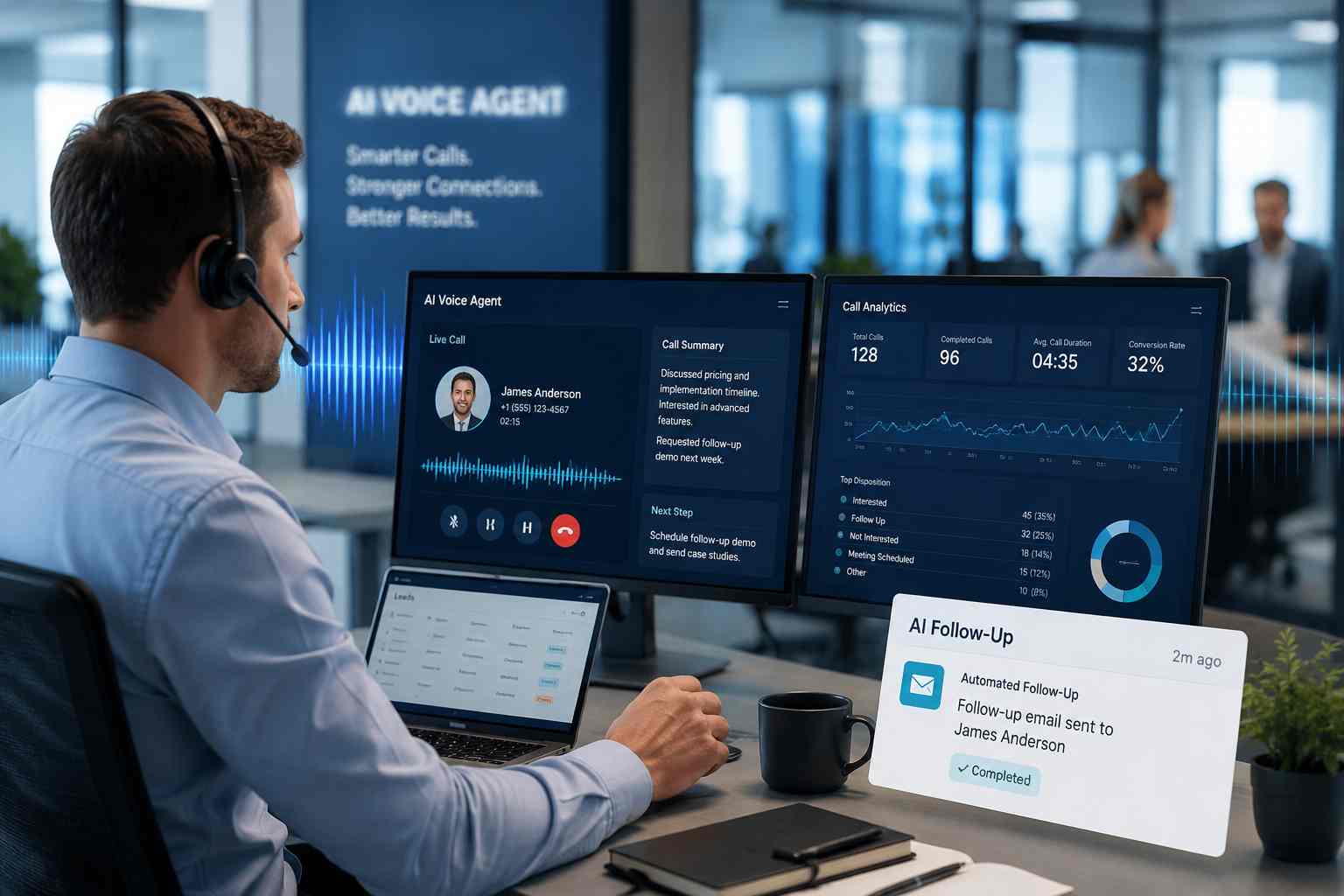
For businesses managing a steady flow of enquiries, the challenge is rarely generating every lead. The bigger challenge is often following up with every lead at the right time and in a consistent way. This is where AI Calling Services in Noida can become part of a modern sales and customer communication strategy.
AI calling combines voice automation, conversational AI, predefined business workflows and, where available, integrations with business systems to handle repetitive calling activities. Instead of depending entirely on manual telecalling for every first contact or follow-up, businesses can automate selected stages of the communication journey.
For a real-estate company, this may mean contacting a new property enquiry and identifying the prospect's preferred location and budget. For an education company, it could mean following up with an admission enquiry. For a B2B organization, an AI voice agent may conduct an initial qualification conversation before a sales representative becomes involved.
The purpose is not simply to make more calls. The real objective is to make lead follow-up more structured, timely, measurable and scalable while allowing human sales teams to concentrate on conversations that require judgement, negotiation and relationship building.
Businesses evaluating AI calling should therefore consider the technology as part of a complete workflow rather than as a replacement for human sales communication.
What Are AI Calling Services in Noida and How Do They Work?
AI Calling Services in Noida use conversational AI and voice automation to conduct predefined or dynamically managed business conversations over telephone channels. Depending on the implementation, an AI voice agent can contact leads, ask qualification questions, provide basic information, schedule appointments, record outcomes and transfer suitable conversations to human teams.
The technology becomes particularly useful when a business has repetitive follow-up activities that consume sales-team time. A well-designed workflow can move a lead from enquiry to initial conversation, qualification and human handoff without requiring a salesperson to manually perform every repetitive step.
BOOK DEMO - https://www.uraiconnect.com/book-a-demo
What Is an AI Calling Service?
An AI calling service is a technology-based calling system that enables automated voice conversations with customers or prospects.
Traditional automated phone systems generally rely on menus such as "Press 1 for sales" or "Press 2 for support." AI voice agents can go further by interpreting spoken responses and conducting a conversational interaction based on the business workflow.
An AI calling system may be designed to:
Contact newly generated leads
Follow up with existing enquiries
Ask qualification questions
Confirm customer requirements
Schedule appointments
Provide basic service information
Collect information
Route qualified prospects
Trigger a human callback
Record conversation outcomes
Support repetitive customer communication
The exact capabilities depend on the technology, configuration, integrations and business process.
For a company searching for an AI calling service in Noida, the important question is therefore not simply whether a provider offers AI calls. The more useful question is whether the system can support the specific customer journey the company needs to automate.
AI Voice Agents and Conversational Calling
An AI voice agent is a software-based conversational system designed to communicate with people through voice.
Instead of following only a rigid keypad menu, a conversational agent can be configured to understand common responses and continue a conversation according to defined objectives.
For example, a property enquiry workflow could begin with:
"Is the enquiry still active?"
The prospect may answer that they are interested but want a property within a particular budget.
The system could then ask relevant qualification questions and record the responses.
A business can design such conversations around its own sales process. The goal is not to make the conversation unnecessarily complex. Effective AI calling workflows usually keep the interaction focused on a clear objective.
Automated Outbound Calling
Automated outbound calling allows a system to initiate calls based on predefined triggers.
A trigger could occur when:
A new lead enters a CRM.
A website form is submitted.
A campaign generates an enquiry.
A callback becomes due.
A prospect needs confirmation.
A customer requires a follow-up.
A sales team wants initial qualification before human contact.
The automation layer can then initiate the appropriate workflow.
This is particularly useful when sales teams face a large number of leads and manual follow-up becomes difficult to manage consistently.
How Does AI Calling Automate Lead Follow-Up?
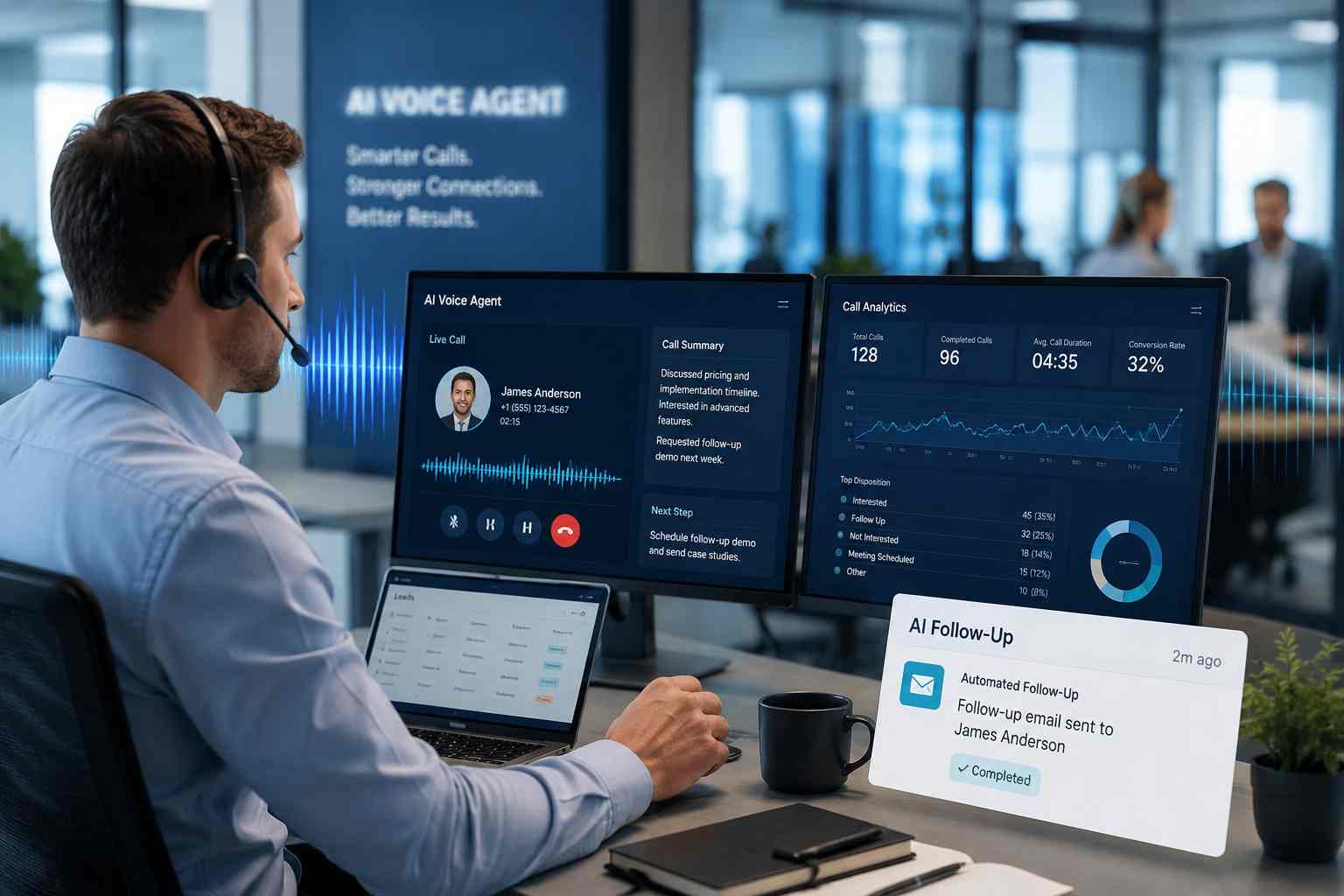
AI calling automates lead follow-up by connecting a lead trigger with a predefined conversation, qualification process and next action. Instead of leaving every follow-up to manual reminders, an automated workflow can initiate contact, capture responses and route the lead according to defined business rules.
A typical workflow can look like this:
Lead Trigger
A lead enters the business system through a website form, advertising campaign, enquiry portal or another source.
The system identifies the lead and determines whether an automated call should be initiated.
Conversation
The AI voice agent begins the conversation using a business-approved script or conversational workflow.
The opening should be clear about the purpose of the call. A good workflow avoids unnecessary questions and respects the recipient's response.
Qualification
The system asks relevant questions.
For example, a B2B company may want to understand:
What service is required?
What is the business requirement?
How soon is the service needed?
Who is responsible for the decision?
Is a consultation required?
A real-estate company may focus on:
Property type
Preferred location
Budget range
Buying or renting requirement
Expected timeline
The questions should reflect the business's actual qualification criteria.
CRM or Team Handoff
Once the conversation is complete, the result can be routed into the next stage of the workflow where supported.
A qualified lead may be passed to a sales representative.
A lead requiring more information may receive another follow-up.
A prospect who is not currently interested may be placed into an appropriate future communication workflow, subject to applicable consent and communication requirements.
The key advantage is that the calling activity becomes part of a structured process rather than an isolated phone call.
What Can an AI Voice Agent Actually Handle?
An AI voice agent can handle repetitive, structured conversations where the business objective and acceptable responses are clearly defined. It is particularly suitable for first-level interactions, qualification, confirmations, reminders and routing.
Lead Qualification
Lead qualification is one of the most practical uses of AI calling.
A voice agent can ask predefined questions and categorize responses based on business rules.
For example:
Lead A: Strong requirement, immediate timeline, relevant budget.
Lead B: Interested but needs information.
Lead C: No current requirement.
This classification can help sales teams prioritize their attention.
Appointment Scheduling
Where the required scheduling system is supported, an AI voice workflow can assist with appointment booking.
A conversation could establish:
Preferred day
Preferred time
Appointment type
Relevant requirement
Contact information
The objective is to reduce unnecessary back-and-forth communication.
Customer Callbacks
Customers who request a callback can become part of an automated follow-up queue.
Instead of relying entirely on a manual reminder, the system can initiate a callback workflow based on the configured process.
BOOK DEMO - https://www.uraiconnect.com/book-a-demo
FAQs and Basic Information
AI voice agents can also handle frequently repeated questions when the underlying information is stable and clearly defined.
Examples include:
Service availability
Basic product information
Appointment information
Business hours
General process questions
More complex questions should be transferred to an appropriate human representative.
Where Does AI Calling Fit Into a Sales Workflow?
AI calling works best when it is placed at specific points in a sales workflow rather than being treated as an independent technology.
A practical workflow can include four stages.
New Lead Response
A new lead enters the system.
An AI calling workflow can initiate the first communication according to the configured process.
The purpose is to establish contact and determine whether the enquiry is genuine and active.
Follow-Up Sequence
If the first call does not result in a completed conversation, a business can define an appropriate follow-up process.
The sequence should not become excessive or intrusive. Communication frequency should reflect the customer's preferences, applicable requirements and business context.
Human Handoff
A lead demonstrating strong purchase intent can be transferred or routed to a sales representative.
This is where AI calling and human selling can work together.
The AI handles repetitive qualification.
The human handles the deeper sales conversation.
When Human Intervention Becomes Necessary
AI calling should not be positioned as suitable for every conversation.
Human involvement becomes especially important when:
A customer has a complex requirement.
Negotiation is involved.
The customer is dissatisfied.
The issue is sensitive.
A high-value decision requires consultation.
The conversation goes outside the configured workflow.
The prospect specifically requests a human representative.
The strongest implementation is often not "AI instead of humans."
It is AI for repetitive communication plus humans for higher-value interactions.
How Can AI Calling Improve Lead Follow-Up for Noida Businesses?
AI Calling Services in Noida can improve lead follow-up by automating repetitive conversations, creating more consistent workflows and helping sales teams prioritize prospects. For businesses handling frequent enquiries, AI can support the early stages of contact and qualification while human representatives focus on complex, high-value or relationship-driven conversations.
What Are the Biggest Benefits of AI Calling?
The main benefits of AI calling come from workflow automation rather than from simply increasing call volume.
Faster Lead Response
When a business receives an enquiry, timing can influence whether the prospect remains engaged.
Manual processes can introduce delays because sales representatives may already be on calls, in meetings or handling other leads.
An automated workflow can help businesses establish a defined response process.
The exact response capability depends on system configuration and integration, but the strategic benefit is straightforward: a lead should not depend entirely on a salesperson remembering to initiate every follow-up manually.
Consistent Follow-Up
Human sales teams can perform excellent follow-up, but manual processes are difficult to standardize at scale.
AI calling can follow a defined workflow.
This creates consistency in areas such as:
Opening statements
Qualification questions
Information collection
Follow-up logic
Lead categorization
Escalation rules
Consistency is particularly valuable for organizations with multiple sales representatives.
Lead Prioritization
Not every lead has the same level of intent.
AI lead qualification can help categorize prospects according to predefined criteria.
A sales team can then concentrate more attention on leads that match its qualification requirements.
This does not guarantee conversion. It simply creates a more organized process for deciding where human attention should go.
Scalable Calling Operations
A manual telecalling operation requires additional people as activity grows.
An AI calling platform can provide a different scaling model for repetitive conversations.
This can be useful for businesses that experience:
Seasonal demand
Marketing campaign spikes
Large enquiry volumes
Multiple geographic markets
Repetitive follow-up requirements
Scalability should still be evaluated alongside call quality, infrastructure, compliance and customer experience.
Which Noida Industries Can Use AI Calling?
Businesses in Noida operate across technology, real estate, education, healthcare, professional services, finance, e-commerce and many other sectors. AI calling can be relevant across these industries when there are repetitive voice-based workflows that can be clearly defined.
Real Estate
Real-estate businesses often handle large volumes of property enquiries.
A potential workflow can include:
New property enquiry arrives.
AI calling initiates contact.
Prospect confirms interest.
Preferred location is discussed.
Budget range is identified.
Buying timeline is assessed.
Qualified prospect is routed to a property consultant.
The human representative can then focus on property recommendations, site visits, negotiations and closing.
This approach is particularly relevant for real-estate teams that receive enquiries from multiple marketing channels.
Education
Education companies and institutions can receive enquiries regarding:
Courses
Admissions
Eligibility
Fees
Counselling
Program schedules
Application processes
An AI voice workflow can perform initial follow-up and collect basic information before routing the enquiry to an admissions representative.
Complex academic or admission questions can remain with human staff.
Healthcare
Healthcare businesses need to approach automation carefully because customer conversations can involve sensitive information.
Appropriate workflows may include administrative communication such as:
Appointment reminders
Appointment confirmations
Basic scheduling
Callback requests
General administrative information
AI calling should not be treated as a substitute for professional medical judgement.
Sensitive or clinical conversations require appropriate human handling and careful data governance.
Financial Services
Financial businesses can have repetitive customer communication requirements, but they also operate in highly regulated environments.
Potential workflows may include administrative follow-up or customer communication where permitted.
Any financial organization considering automated calling should evaluate applicable regulatory requirements, customer consent, data handling and communication rules before deployment.
E-Commerce
E-commerce businesses may use voice automation for selected customer communication workflows such as:
Order-related follow-up
Customer callbacks
Service requests
Basic confirmation processes
The exact use case depends on the business model and communication requirements.
B2B and Service Businesses
B2B businesses often have longer sales cycles.
An AI calling workflow can assist with initial qualification by identifying whether a company has:
A relevant requirement
An active project
A suitable timeline
The right decision-maker
A need for consultation
The qualified opportunity can then move to a human sales process.
Can AI Calling Qualify Sales Leads?
Yes. AI calling can qualify sales leads when the business defines clear qualification criteria and the AI workflow is configured to ask relevant questions, interpret supported responses and assign the lead to an appropriate next step.
The quality of qualification depends heavily on the workflow design.
Qualification Questions
A business should first identify the information that actually matters.
For example:
B2B software
Business type
Current system
Main requirement
Number of users
Expected implementation timeline
Real estate
Property requirement
Preferred location
Budget
Timeline
Purchase or rental intent
Education
Course interest
Eligibility
Preferred intake
Counselling requirement
The questions should be short and relevant.
Intent Detection
The AI workflow can be configured around different types of responses.
A prospect may show:
High intent
Moderate interest
Information-seeking intent
No current requirement
The system can then trigger different next steps.
Lead Routing
Qualification becomes more useful when it leads to action.
A high-intent lead can be routed to sales.
A lead requesting information can receive an appropriate follow-up.
A lead that is not currently interested can be handled according to the company's permitted communication process.
The objective is to turn conversation data into an operational decision.
Can AI Calling Replace Human Telecallers?
AI calling can automate many repetitive telecalling tasks, but it should not automatically be treated as a complete replacement for human representatives. Human salespeople remain important for complex discussions, negotiation, relationship building, objections, sensitive conversations and situations requiring judgement.
AI CallingTraditional TelecallingSoftware-driven voice conversationsHuman-led conversationsSuitable for repetitive workflowsFlexible across complex conversationsCan follow standardized qualification flowsCan adapt naturally to unexpected situationsUseful for high-volume repetitive follow-upRequires human capacity for each conversationConsistent scripted or configured processIndividual representatives may use different approachesCan support automated lead routingRepresentatives manually decide next actionsUseful for first-level qualificationStrong for relationship-based sellingRequires careful workflow designRequires hiring, training and managementAnalytics can be built into the workflowAnalytics depend on call-recording and reporting systemsHuman handoff can be added for complex casesHuman interaction is inherent
The practical question is therefore not whether AI or humans are universally better.
The better question is:
Which parts of the customer journey should be automated, and which parts require human expertise?
What Should Businesses Measure After Implementing AI Calling?
Businesses should measure operational and sales-process indicators rather than assuming that the number of calls automatically represents success.
Contact Rate
How many leads successfully enter a conversation?
This helps identify whether the calling workflow is reaching the intended audience.
Qualification Rate
How many completed conversations produce usable qualification information?
A high contact volume with poor qualification may indicate that the workflow needs improvement.
Appointment Rate
For appointment-based businesses, the number of qualified conversations resulting in appointments can be useful.
Handoff Quality
A particularly important measure is the quality of leads transferred to human representatives.
A sales team should receive enough context to continue the conversation efficiently.
Other useful operational measures can include:
Call completion rate
Follow-up completion
Callback requests
Conversation duration
Human-transfer rate
Unsuccessful contact rate
Lead-status accuracy
Customer feedback
Metrics should be evaluated against the business's actual objective.
A lead-generation company may prioritize qualified opportunities.
A service business may prioritize appointment completion.
A customer-service operation may prioritize successful resolution or routing.
How Should a Business Choose AI Calling Services in Noida?
A business evaluating AI Calling Services in Noida should assess the provider against its actual calling workflow, integration requirements, conversation quality, scalability, analytics, multilingual needs, human handoff and compliance responsibilities. The best solution is not necessarily the one with the longest feature list; it is the one that fits the business process and customer experience.
What Features Should an AI Calling Platform Provide?
A strong AI calling solution should be evaluated across several technical and operational areas.
Voice and Conversation Management
The voice experience matters because customers interact with the system through conversation.
Businesses should assess:
Voice quality
Conversation flow
Response handling
Interruption handling
Escalation logic
Script flexibility
Business-specific terminology
A technically capable system can still create a poor customer experience if conversations sound unnatural or fail to handle common responses.
CRM Integration
CRM integration can be important because calling should not exist separately from the sales process.
A connected workflow can help associate:
Lead information
Call outcomes
Qualification responses
Follow-up status
Assigned sales representative
Next action
Before choosing a provider, a business should confirm exactly which CRM systems and integration methods are supported.
Call Analytics
Analytics can help managers understand what happens after calls begin.
Useful reporting may include:
Call outcomes
Qualification results
Call duration
Transfer activity
Follow-up status
Conversation categories
The goal is to turn calling activity into information that can improve the sales process.
Multilingual Support
India's business environment includes customers with different language preferences.
For businesses serving diverse audiences, multilingual AI voice capability can be an important consideration.
The provider should be evaluated on actual conversational quality in the required languages rather than simply checking whether a language appears on a feature list.
How Much Do AI Calling Services in Noida Cost?
There is no single universal price for AI calling services in Noida. Cost can vary according to call volume, voice technology, infrastructure, integrations, workflow complexity, language requirements, analytics, human handoff, support and the provider's pricing model.
Pricing Variables
A business evaluating pricing should examine:
Number of calls
Calling duration
Number of concurrent conversations
Required languages
CRM integration
Custom workflow development
Analytics requirements
Voice infrastructure
Human-transfer requirements
Implementation and support
Two businesses making the same number of calls can therefore have different total costs because their workflows and technical requirements are different.
Usage-Based Considerations
Some AI calling solutions may be influenced by usage.
For example, higher call duration or greater calling volume can affect operational costs.
Businesses should therefore calculate the cost per useful business outcome, not simply cost per call.
A useful evaluation can compare:
Total calling cost ÷ qualified opportunities generated
or, for appointment-driven businesses:
Total calling cost ÷ completed qualified appointments
These calculations should use the company's actual data rather than generic industry claims.
AI Calling vs Traditional Telecalling: Which Approach Fits Better?
The answer depends on the type of conversation.
Traditional telecalling remains valuable when conversations require empathy, negotiation, persuasion, complex problem solving or detailed customer interaction.
AI calling is especially useful when conversations are:
Repetitive
Structured
High volume
Qualification-oriented
Reminder-based
Information-driven
Suitable for predefined workflows
A hybrid model can combine both.
For example:
Stage 1: AI contacts a new lead.
Stage 2: AI identifies the basic requirement.
Stage 3: The qualified lead is routed to a salesperson.
Stage 4: The salesperson conducts the detailed consultation.
Stage 5: AI can support selected follow-up activities.
This model allows automation to support the sales team without forcing every customer interaction into an automated conversation.
What Compliance and Data Considerations Matter in India?
Businesses using automated calling for commercial communication in India should treat compliance as a core implementation requirement rather than an afterthought. TRAI's current regulatory framework addresses commercial communications, sender registration and customer preferences, while applicable data-protection and sector-specific requirements should also be considered.
TRAI states that entities sending bulk commercial communications through telecom resources are required to fulfil applicable requirements under the Telecom Commercial Communications Customer Preference Regulations framework.
Businesses should therefore review the current requirements before launching commercial voice campaigns.
Commercial Calling Requirements
The regulatory environment can distinguish between different types of communications.
Businesses should understand whether a planned workflow involves:
Promotional communication
Service communication
Transaction-related communication
Customer-requested communication
Other categories governed by applicable telecom rules
TRAI's guidance explains that commercial communication is subject to requirements concerning registered senders and other elements of the framework.
Because telecom regulations can change, businesses should use current official regulatory guidance when designing production campaigns rather than relying on old blog posts or informal advice.
TRAI commercial communication guidance
Consent and Customer Preferences
Consent and customer preferences are important considerations for automated calling.
A business should know:
Where the contact information originated
What permission was obtained
What type of communication is intended
Whether the customer has expressed preferences
How opt-out requests are handled
How records are maintained
The automation system should support the organization's compliance process rather than bypass it.
Data Handling
AI calling can process customer information, including contact details and conversation data.
Businesses should therefore establish appropriate policies for:
Data access
Data storage
Retention
Security
User permissions
Recording policies
Vendor access
Data deletion
Integration security
The more sensitive the business sector, the more carefully these areas should be evaluated.
How Can Urai Connect Fit Into an AI Calling Strategy?
Urai Connect can be evaluated as part of a business strategy focused on AI-powered communication, automated lead follow-up and calling workflows. The appropriate role depends on the organization's requirements, including its lead process, communication objectives, integration needs and desired level of automation.
For businesses researching AI Calling Services in Noida, Urai Connect can be considered alongside other providers based on practical requirements rather than brand recognition alone.
Urai Connect AI communication platform
A business evaluation can focus on questions such as:
What type of leads need automated follow-up?
Which calls should be automated?
Which calls require human intervention?
What qualification information is required?
How should qualified leads reach the sales team?
What reporting is required?
Which languages are needed?
What integrations are necessary?
What compliance process must be followed?
These questions help ensure that AI calling is implemented around a real business objective.
A company can also review the Urai Connect platform to understand how its communication capabilities may fit into a broader automation strategy.
Explore Urai Connect for business communication automation
How Should a Business Plan an AI Calling Implementation?
A successful implementation should begin with the workflow, not the technology.
Step 1: Identify the Repetitive Calling Task
The business should identify calls that are frequent and structured.
Examples include:
New lead follow-up
Appointment confirmation
Basic qualification
Callback handling
Customer reminders
Step 2: Define the Desired Outcome
Every automated call should have a clear purpose.
For example:
Objective: qualify a property enquiry.
The system should know which information needs to be collected before the call is considered successful.
Step 3: Design the Conversation
The conversation should be short, clear and customer-focused.
A workflow should include:
Opening
Purpose
Questions
Response handling
Qualification
Next action
Human handoff
Closing
Step 4: Define Failure Conditions
A good workflow should also define what happens when the AI cannot complete the conversation.
For example:
Customer asks for a human
Customer gives an unexpected answer
Customer is dissatisfied
Required information is unavailable
Conversation becomes too complex
These conditions should trigger an appropriate human or alternate workflow.
Step 5: Test Before Scaling
A business should test the workflow with representative scenarios before using it across a large lead pool.
Testing should cover:
Common responses
Unexpected responses
Different accents
Language changes
Interruptions
Questions outside the script
Human-transfer requests
Negative responses
Opt-out requests
Step 6: Measure and Improve
After deployment, conversation outcomes should be reviewed.
The business can identify where customers:
End calls early
Ask repeated questions
Request human assistance
Fail qualification
Misunderstand the workflow
Those observations can be used to improve the conversation design.
What Makes AI Calling Effective for Noida Businesses?
Local relevance is not created by inserting the word "Noida" into every paragraph. It comes from understanding the types of organizations operating in the area and the business problems they face.
A growing company with a large digital lead pipeline may need rapid lead qualification.
A real-estate business may need systematic property enquiry follow-up.
An education company may need admission enquiry management.
A B2B organization may need initial prospect qualification.
A service company may need appointment-related communication.
In each case, the business problem is different even though the underlying technology may be similar.
For this reason, a good AI calling solution for businesses should be configured around the workflow rather than around a generic script.
What Are the Common Mistakes Businesses Make With AI Calling?
AI calling can fail when organizations focus only on automation and ignore customer experience.
Automating a Poor Process
Automation does not automatically improve a broken process.
If a sales team does not know which leads are qualified, automating the same unclear process may simply create more confusion.
Asking Too Many Questions
A voice interaction should respect the customer's time.
Long qualification scripts can make the conversation feel like an interrogation.
Only information that influences the next action should normally be collected during the initial interaction.
No Human Handoff
An AI system should have a clear path to human assistance when the conversation requires it.
Ignoring Customer Preferences
Commercial calling should be designed around applicable telecom requirements and customer preferences.
Measuring Calls Instead of Outcomes
A large number of calls does not necessarily mean a successful sales operation.
The more useful question is:
What business outcome did those conversations create?
How Can Businesses Make AI Calling More Human-Centered?
The best AI calling workflows are not necessarily the ones that attempt to imitate humans in every way.
They are the ones that make conversations easier for customers.
A human-centered workflow should:
Clearly identify the purpose of the call
Avoid unnecessary repetition
Ask relevant questions
Understand common responses
Respect customer preferences
Provide an easy human handoff
Avoid pretending to be a human representative
End the interaction when the objective is complete
The customer's experience should remain the central consideration.
What Should a Business Ask an AI Calling Provider Before Buying?
A provider evaluation should include practical questions.
Technology
How does the voice agent handle interruptions?
How are workflows configured?
Which languages are supported?
How are failed conversations handled?
Integration
Which CRM systems are supported?
Can call outcomes be synchronized?
What APIs or integration options exist?
Operations
How are calls monitored?
What analytics are available?
How are workflows updated?
How does human handoff work?
Security and Compliance
How is customer information handled?
What data-retention options exist?
What controls are available for recordings?
How does the solution support applicable telecom requirements?
Commercials
Is pricing usage-based?
Are setup costs separate?
Are integrations included?
Are support costs separate?
What happens when call volume increases?
These questions provide a more reliable basis for comparison than simply comparing feature lists.
Frequently Asked Questions About AI Calling Services in Noida
What are AI Calling Services in Noida?
AI Calling Services in Noida are automated voice communication solutions that can conduct structured conversations with prospects or customers. They can support activities such as lead follow-up, qualification, appointment-related communication and routing to human representatives.
How do AI calling services help businesses in Noida?
AI calling can help businesses organize repetitive calling workflows, follow up with enquiries, qualify leads and route suitable prospects to sales teams. The value is strongest when calling is integrated into a clearly defined business process.
How does AI calling improve lead follow-up?
AI calling can create a structured follow-up process so that repetitive communication does not depend entirely on manual reminders. It can initiate configured conversations, collect responses and determine the next workflow step.
Can AI calling qualify leads?
Yes. An AI voice agent can ask predefined qualification questions and categorize responses according to business rules. Qualified leads can then be routed to human sales representatives where the workflow supports such handoff.
Can AI voice agents schedule appointments?
AI voice agents can support appointment scheduling when the required scheduling system and workflow are properly integrated. The exact capability depends on the platform and implementation.
How much do AI calling services in Noida cost?
There is no single fixed price. Cost can depend on call volume, duration, integrations, languages, workflow complexity, infrastructure and support requirements. Businesses should evaluate total cost against useful business outcomes rather than only cost per call.
Is AI calling better than traditional telecalling?
Neither approach is universally better. AI calling is useful for repetitive and structured workflows, while human telecallers are stronger for complex conversations, negotiation, relationship building and situations requiring judgement. A hybrid approach can combine both.
Can AI calling integrate with a CRM?
Many AI calling implementations can integrate calling activity with business systems, but the exact CRM and integration capabilities depend on the provider. Businesses should verify supported systems before implementation.
Can AI calling handle multiple languages?
Multilingual AI calling is possible with suitable technology, but businesses should evaluate actual conversational quality in the required languages rather than relying only on a feature list.
How should a business choose an AI calling service?
A business should evaluate conversation quality, workflow flexibility, CRM integration, analytics, human handoff, language support, scalability, data handling, compliance requirements and total cost. The provider should fit the business's actual customer journey.
Conclusion
AI Calling Services in Noida can become a practical part of modern lead follow-up when automation is applied to the right stages of the customer journey. The strongest use cases are generally repetitive, structured activities such as initial lead contact, basic qualification, appointment-related communication and follow-up workflows.
For businesses handling high enquiry volumes, AI calling can provide a structured way to support sales teams without requiring every repetitive interaction to be handled manually.
However, successful implementation requires more than an AI voice agent. The business needs a clear workflow, useful qualification criteria, appropriate human handoff, reliable reporting and responsible handling of customer communication and data.
AI should therefore be viewed as a sales and communication automation layer, not as a universal replacement for human representatives.
For Noida businesses evaluating this technology, the practical starting point is to identify one repetitive calling process, define its desired outcome, build a focused workflow, test it with realistic conversations and measure the results.
Urai Connect can be considered as part of that evaluation for organizations exploring AI-powered business communication and automated calling workflows.
The most valuable AI calling strategy is ultimately the one that makes lead follow-up more organized while preserving the quality of the customer experience.
Key Takeaways
AI calling can automate repetitive voice-based business workflows.
Lead follow-up is one of the strongest practical use cases.
AI voice agents can support initial qualification and routing.
Human representatives remain important for complex sales conversations.
CRM integration can connect calling with the broader sales process.
Businesses should measure outcomes rather than call volume alone.
Compliance and customer preferences must be considered before commercial calling campaigns.
Pricing depends on usage, workflow complexity, integrations and other requirements.
Noida businesses across multiple sectors can evaluate AI calling according to their specific workflows.
Urai Connect can be evaluated as a potential platform for AI-powered business communication and calling automation.