
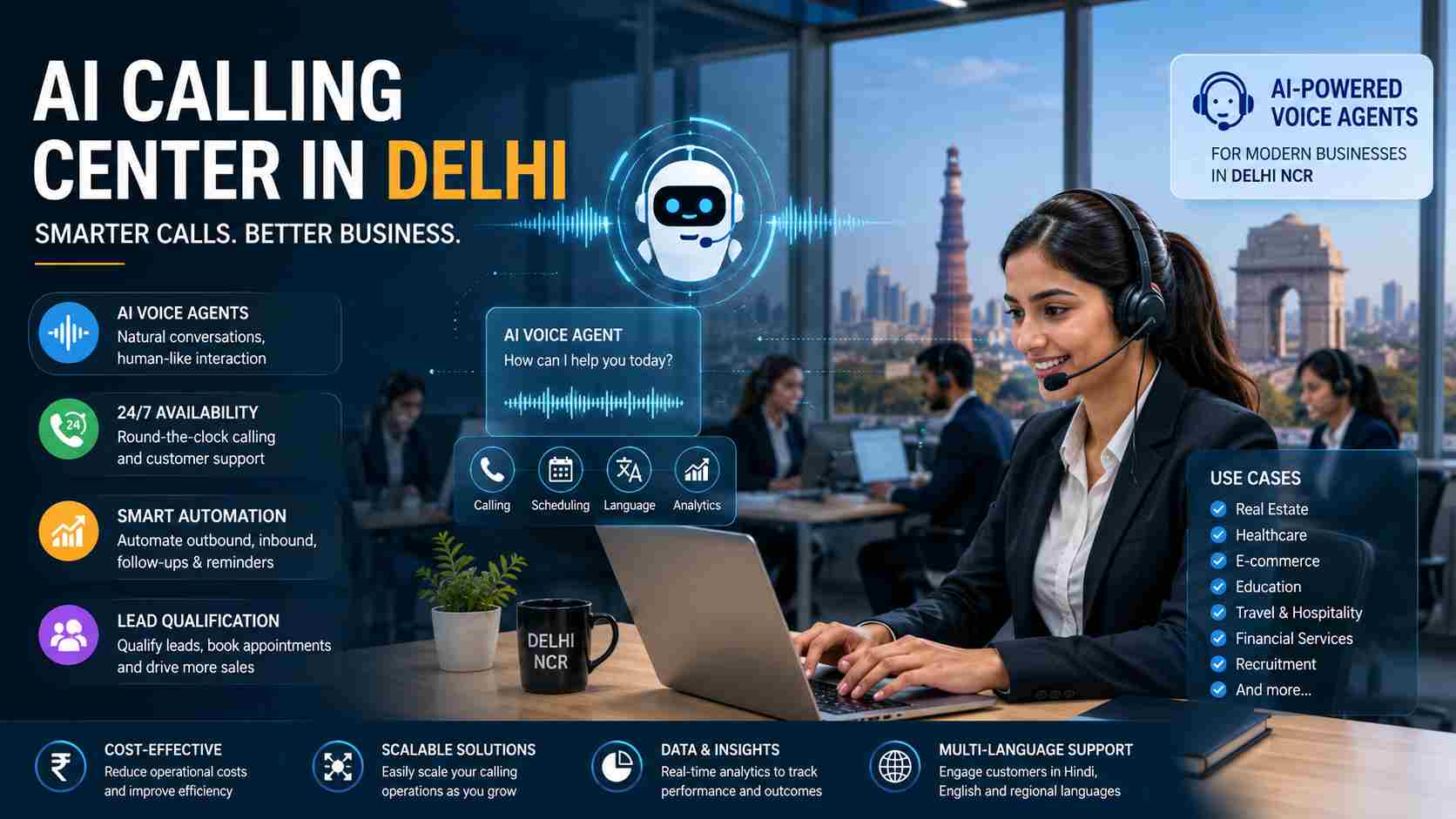
Businesses in Delhi are increasingly looking for faster and more scalable ways to manage customer conversations, sales enquiries, lead follow-ups, appointment confirmations, and routine service calls. An AI Calling Center in Delhi can help automate many of these conversations through AI voice agents that understand spoken language, respond to customers, collect information, and perform predefined actions.
Unlike a traditional call center that depends primarily on human agents, an AI-powered call center uses conversational AI, speech recognition, voice technology, business rules, and software integrations to automate selected calling processes. Depending on the implementation, AI can handle inbound calls, outbound calls, lead qualification, appointment reminders, customer support, surveys, and follow-ups.
For businesses operating in Delhi and serving customers across nearby markets such as Noida, Gurugram, Ghaziabad, and Faridabad, the technology can be particularly useful when call volumes are high or when repetitive communication takes significant employee time.
However, AI calling is not simply a matter of replacing human telecallers with software. A successful implementation requires the right conversation design, reliable integrations, appropriate escalation rules, data protection, monitoring, and compliance with applicable telecom requirements.
This guide explains how an AI calling center works, what an AI calling agent can do, where the technology fits, what affects cost, how businesses can evaluate providers, and what decision-makers should consider before implementation.
What Is an AI Calling Center in Delhi and How Does It Work?
An AI Calling Center in Delhi is a technology-based customer communication system that uses artificial intelligence and voice automation to conduct or assist with telephone conversations. It can receive incoming calls or initiate permitted outbound calls, understand customer speech, provide responses, collect information, and trigger business actions according to predefined workflows.
An AI calling center generally combines several technologies. These may include automatic speech recognition, natural-language processing, conversational AI, text-to-speech, telephony infrastructure, business rules, CRM integrations, analytics, and human-agent escalation.
The important distinction is that AI calling is not limited to playing a recorded message. A conversational AI voice agent can interpret what a caller says and select an appropriate response based on the conversation context.
For example, a real estate company may receive an enquiry from a potential buyer. Instead of simply playing a recorded message, an AI calling agent could ask what type of property the customer is interested in, understand the answers, collect preferred location and budget information, and pass the qualified lead to a human sales representative.
What Is an AI Calling Agent?
An AI calling agent is a software-based voice assistant designed to communicate with customers over telephone channels. It can be configured to follow a specific conversation flow while responding dynamically to customer questions and answers.
A typical AI calling agent can be designed to:
Greet customers.
Identify the purpose of a call.
Ask predefined questions.
Understand spoken responses.
Collect customer information.
Qualify leads.
Confirm appointments.
Provide basic information.
Conduct surveys.
Make follow-up calls.
Route suitable conversations to human employees.
Record conversation outcomes.
Update connected business systems.
The exact capabilities depend on the AI platform, telephony infrastructure, integrations, language support, and business workflow.
The strongest implementations do not attempt to make AI responsible for every possible customer situation. Instead, the AI handles clearly defined tasks while human employees handle exceptions, sensitive conversations, negotiations, complaints, or situations requiring judgment.
How Does AI Voice Calling Work?
AI voice calling generally follows a sequence of connected technologies.
A customer makes or receives a call.
The telephony system connects the conversation.
Speech recognition converts spoken language into machine-readable text or intent.
The conversational AI interprets the customer's request.
Business rules and conversation context determine the appropriate response.
A voice-generation system converts the response into spoken language.
The customer hears the response.
The system continues the conversation until the task is completed, escalated, or terminated.
Relevant information can be stored in the business system.
The process can happen quickly enough to create a conversational experience rather than the rigid interaction associated with older automated phone systems.
The quality of the experience depends heavily on conversation design. A technically advanced AI system can still produce a poor customer experience if the script is confusing, the questions are repetitive, or the escalation process is unclear.
What Technologies Power an AI Calling Center?
Several technologies can work together inside an AI-powered call center.
Automatic Speech Recognition
Speech recognition converts spoken language into information the AI can process.
Conversational AI
Conversational AI interprets questions, intent, context, and responses to determine what should happen next.
Text-to-Speech
Text-to-speech technology produces the spoken voice heard by the customer.
Telephony Infrastructure
Telephony systems connect the AI application with telephone networks and business numbers.
CRM Integration
CRM integration allows customer information and call outcomes to move between the AI calling system and business software.
Analytics
Call analytics can help businesses review outcomes such as completed calls, customer responses, transferred conversations, appointment requests, and lead qualification results.
Workflow Automation
Workflow automation can connect calls with actions such as creating a lead, updating a CRM record, sending a follow-up message, or notifying a sales representative.
What Is the Difference Between AI Calling and Traditional Calling?
Traditional call centers depend heavily on human agents to answer, make, document, and follow up on calls. AI calling centers automate selected parts of that process through software.
The comparison does not mean that AI is always better than human calling. The appropriate model depends on the business process.
Human agents remain valuable for negotiations, complex complaints, relationship management, high-value sales conversations, and situations requiring empathy or judgment.
AI becomes particularly useful where the same type of conversation occurs repeatedly and can be clearly defined.
Why Are Businesses in Delhi Adopting AI Calling Solutions?
Businesses often face a simple operational problem: customer communication increases faster than internal teams can manage it.
A sales team may have hundreds of leads requiring follow-up. A clinic may need to confirm appointments. An education company may need to contact prospective students. A service company may need to remind customers about scheduled visits.
When employees spend a large portion of their working day performing repetitive calls, AI call automation can become an operational tool rather than simply a technology experiment.
Delhi has a broad business ecosystem covering professional services, retail, healthcare, education, real estate, hospitality, financial services, recruitment, automotive, and local service businesses. Each sector has different communication requirements, but many share the need for timely customer interaction.
What Business Problems Can AI Calling Solve?
AI calling can address several common communication problems.
Missed follow-ups
A sales representative may receive a lead but fail to follow up immediately because of meetings, workload, or competing priorities.
An automated workflow can initiate an appropriate follow-up process where permitted.
Repetitive customer calls
Some businesses repeatedly make calls for appointment confirmation, enquiry follow-up, reminders, surveys, or information collection.
These activities can often be standardized.
High call volumes
When a campaign or business event produces a large number of enquiries, human teams can become overloaded.
AI can help absorb defined parts of the communication workload.
Inconsistent scripts
Different employees may explain the same product or process differently.
An AI calling workflow can use a standardized conversation structure.
Manual data entry
Employees may spend time writing down information after every call.
An integrated system can capture structured responses automatically when the workflow supports it.
What Benefits Can an AI Calling Center Provide?
The potential benefits depend on the implementation, but common advantages include:
Faster response to suitable enquiries.
Automated follow-up workflows.
Reduced repetitive manual calling.
Consistent communication.
Structured lead qualification.
Appointment scheduling support.
Customer information collection.
Call outcome tracking.
Better visibility into communication activity.
Ability to handle defined workflows outside normal employee working hours.
The benefit is not simply the number of calls an AI system can make or receive.
A better measure is whether the system improves a business process.
For example, if a sales team receives 500 leads but only has time to follow up with 300, the value of automation may come from improving the follow-up process for the remaining leads rather than from generating a large number of calls.
Which Businesses Can Benefit From AI Calling in Delhi?
AI calling can be relevant to many industries, although the appropriate workflow will differ.
Real Estate
Real estate companies often receive enquiries from multiple channels. An AI calling agent can assist with initial lead qualification by asking about property type, preferred location, budget, buying timeline, or other predefined criteria.
A qualified conversation can then be routed to a human sales representative.
Healthcare
Clinics and healthcare organizations may use voice automation for administrative communication such as appointment reminders or confirmations.
Healthcare organizations should be particularly careful about privacy, sensitive information, consent, and escalation to appropriate staff.
Education
Education companies and institutes can use AI calling to follow up with prospective students, confirm enquiry details, answer basic questions, and identify students who require human counselling.
E-commerce
E-commerce businesses may use voice automation for selected customer service workflows, order-related communication, surveys, or follow-ups where the use case and regulatory requirements permit it.
Financial Services
Financial businesses can have strict compliance and security requirements. AI calling may be useful for clearly defined service workflows, but sensitive financial interactions should be designed with appropriate security and human escalation.
Travel and Hospitality
Hotels, travel agencies, and hospitality companies may use AI voice agents for enquiry handling, booking-related workflows, reminders, and customer communication.
Recruitment
Recruitment companies can use AI calling for initial candidate screening, interview reminders, availability checks, or information collection.
Automotive
Dealerships and automotive service businesses can use automated calls for enquiry follow-ups, service reminders, test-drive scheduling, and lead qualification.
Local Service Businesses
Home services, repair companies, training businesses, and other local service providers can use AI calling to handle enquiries, schedule appointments, and follow up with customers.
Can AI Calling Support Hindi and English Conversations?
AI voice systems can be configured for multiple languages and conversational patterns, but language performance varies by platform, voice model, pronunciation, background noise, accents, and conversation design.
For businesses serving Delhi, Hindi-English communication can be particularly relevant.
A customer may begin a conversation in English and switch to Hindi. Another customer may use Hindi with English business terms. The system needs to be tested with realistic customer speech rather than evaluated only through scripted demonstrations.
Before implementation, a business should test:
Hindi pronunciation.
English pronunciation.
Hinglish conversations.
Different accents.
Noisy environments.
Interruptions.
Customer questions outside the main script.
Requests for a human agent.
Misunderstood responses.
Language capability should be treated as a measurable feature rather than a marketing claim.
How Much Does an AI Calling Center in Delhi Cost in 2026?
The cost of an AI Calling Center in Delhi varies according to the technology, call volume, telephony charges, AI usage, integrations, customization, number of agents or workflows, and support requirements.
There is no single price that applies to every business.
Some businesses may need a simple AI voice agent for one workflow. Others may require multiple agents, CRM integration, analytics, custom conversation design, multilingual support, inbound and outbound calling, and human escalation.
A practical pricing evaluation should therefore look at the total cost of the communication workflow rather than only the advertised per-minute or subscription price.
What Factors Affect AI Calling Costs?
Several factors can influence pricing.
Call volume
More minutes and interactions generally increase usage-related costs.
Inbound versus outbound use
The infrastructure and workflow requirements can differ between inbound and outbound communication.
AI voice usage
Speech recognition, language processing, and voice generation may contribute to usage costs.
Telephony
Telephone connectivity can create additional costs depending on the provider and calling configuration.
CRM integration
Connecting an AI calling system with CRM or business software may require setup and development work.
Custom workflows
A basic FAQ workflow is different from a complex sales qualification system with multiple branches.
Language requirements
Multilingual conversations may require additional configuration and testing.
Analytics and reporting
Advanced reporting requirements can influence the overall solution cost.
Human escalation
If AI conversations need to be transferred to human agents, the business needs appropriate call-routing infrastructure and staffing.
Is AI Calling Cost-Effective for Small Businesses?
AI calling can be useful for small businesses when the automation addresses a genuine workload problem.
A small business does not necessarily need a large AI call center.
For example, a local service company may only need:
Incoming enquiry handling.
Basic service information.
Appointment scheduling.
Lead qualification.
Human transfer for complex requests.
That narrower implementation may be more practical than attempting to automate every customer interaction.
The key question is not whether a business is large enough for AI.
The better question is whether the business has a repetitive, measurable communication process that can be improved through automation.
How Can Businesses Measure AI Calling ROI?
Businesses should establish measurable objectives before deployment.
Useful metrics can include:
Number of calls handled.
Qualified leads generated.
Appointment requests.
Appointment completion rate.
Human transfers.
Call completion rate.
Average conversation duration.
Customer response rate.
Follow-up completion.
Cost per qualified lead.
Cost per appointment.
Employee time saved.
Conversion rate after AI qualification.
For example, a business could compare the cost of manually following up with leads against the cost of an automated qualification workflow.
ROI should not be calculated from call volume alone.
A system that completes thousands of low-quality conversations may provide less value than one that handles fewer but more relevant customer interactions.
What Should Businesses Check Before Choosing an AI Calling Provider?
A business evaluating an AI calling provider should examine more than the voice demo.
Important evaluation areas include:
Conversation quality
Can the AI understand natural customer speech?
Workflow flexibility
Can the business create the exact conversation flow required?
Integration
Can the platform connect with CRM, calendars, helpdesk systems, or other relevant software?
Human handoff
Can customers reach a human when necessary?
Reporting
Can managers understand what happened during calls?
Language support
Can the platform handle the languages and speech patterns relevant to the target customers?
Security
How is customer information stored, transmitted, and managed?
Compliance support
Can the provider explain how the calling workflow should be configured to meet applicable requirements?
Scalability
Can the system support increased call volumes without requiring a complete redesign?
Support
Is technical assistance available when a workflow fails or requires modification?
How Can a Business Implement an AI Calling Center Successfully?
A successful AI calling implementation begins with a business process rather than with the technology.
An AI Calling Center in Delhi can be powerful, but the best results usually come when businesses first identify a specific communication problem and then design automation around it.
The implementation can begin with one workflow and expand after performance has been evaluated.
What Calls Can an AI Calling Agent Handle?
The appropriate use cases depend on the business, but AI calling agents can be configured for tasks such as:
Lead follow-ups.
Enquiry handling.
Appointment reminders.
Appointment confirmations.
Basic customer support.
Customer surveys.
Lead qualification.
Information collection.
Event reminders.
Service reminders.
Candidate screening.
Test-drive scheduling.
Sales follow-ups.
Feedback collection.
The suitability of each use case depends on customer expectations, legal requirements, risk, and the complexity of the conversation.
High-risk decisions should not automatically be delegated to an AI voice agent simply because the technology can technically conduct the conversation.
Can AI Qualify Leads and Book Appointments?
Yes, AI can be configured to ask qualifying questions and support appointment workflows when connected to the appropriate business systems.
Consider a real estate example.
A potential customer submits an online enquiry.
The AI calling agent could ask:
What type of property is required?
Which location is preferred?
What is the approximate budget?
Is the customer looking to buy or rent?
When is the customer planning to move?
Based on the responses, the system could categorize the enquiry according to predefined criteria.
If the business calendar is integrated, the system may also support appointment scheduling.
The human sales team can then focus on conversations that require negotiation, detailed product knowledge, or relationship building.
Can AI Transfer Calls to Human Agents?
Human escalation is one of the most important parts of a good AI calling workflow.
An AI system should not continue a conversation indefinitely when the customer clearly wants a person.
Human transfer can be appropriate when:
The customer requests an employee.
The issue is complex.
The customer is dissatisfied.
The conversation involves sensitive information.
The AI cannot understand the request.
The customer wants to negotiate.
A business policy requires human review.
A well-designed AI calling center therefore operates more like a combination of automation and human support rather than a complete replacement for employees.
How Should Businesses Handle Compliance and Customer Consent?
Compliance should be treated as a core implementation requirement.
In India, TRAI distinguishes different forms of commercial communication and provides requirements concerning consent, registered senders, headers, content templates, and customer preferences. TRAI also states that promotional voice calls without explicit consent can constitute commercial communication concerns under its framework.
TRAI's current consumer guidance states that unwanted commercial messages and voice calls can be treated as unsolicited commercial communication when they are not supported by applicable consent or registered preference.
The regulatory environment is also evolving around automated and application-generated voice communication. TRAI's 2026 draft regulatory work specifically discusses A2P calls, including calls initiated by applications or automated systems, and measures relating to automated calling.
Businesses should therefore avoid assuming that an AI calling platform automatically makes every outbound calling campaign compliant.
Before launching a commercial AI calling campaign, businesses should review:
Whether the communication is promotional, transactional, or service-related.
Whether customer consent is required.
Whether applicable customer preferences permit the communication.
Whether sender registration requirements apply.
Whether required voice or content templates are applicable.
Whether the telecom provider and AI calling provider support the required compliance process.
Whether customers can request appropriate communication preferences.
Whether call records and consent information are maintained properly.
Businesses should consult the applicable current TRAI and Department of Telecommunications requirements for their specific calling model. The Department of Telecommunications also maintains current authorisation information for enterprise communication services under the Telecommunications Act framework.
Start With One Business Process
A common implementation mistake is attempting to automate everything immediately.
A better approach is to select one process.
For example:
Lead follow-up → AI qualification → CRM update → human sales call
This workflow is easier to test than an AI system responsible for every sales and support conversation.
Once the process works reliably, other workflows can be added.
Build a Clear Conversation Flow
The AI needs clear instructions.
A useful conversation design defines:
Opening statement.
Purpose of the call.
Questions.
Possible customer responses.
Business rules.
Objection handling.
Information the AI is allowed to provide.
Information it must not provide.
Escalation conditions.
Closing statement.
CRM actions.
The clearer the workflow, the easier it becomes to monitor and improve.
Monitor Calls and Improve the AI
AI calling should be treated as an ongoing process.
Businesses should regularly review:
Failed conversations.
Customer complaints.
Misunderstood questions.
Incorrect responses.
Unnecessary transfers.
Calls that ended too early.
Questions the AI could not answer.
Leads incorrectly categorized.
These insights can be used to improve prompts, scripts, knowledge sources, business rules, and escalation paths.
Keep Human Escalation Available
The goal of automation should not be to prevent customers from reaching people.
Instead, AI can handle predictable communication while humans focus on situations where human judgment adds more value.
This hybrid model can be particularly useful for businesses with sales or support teams.
How Can Urai Connect Support AI Calling Use Cases?
For businesses evaluating an AI calling solution, Urai Connect can be considered as one potential technology provider for AI-powered communication.
Its AI Calling Agent offering is positioned around AI-based voice communication and business calling workflows. Businesses evaluating the service can review the available capabilities directly on the Urai Connect AI Calling Agent page.
The right way to evaluate Urai Connect, or any other AI calling provider, is to match the platform's actual capabilities with the business workflow.
For example, a business may need:
AI lead follow-up.
Automated calling.
AI voice conversations.
Customer enquiry handling.
Lead qualification.
Appointment-related communication.
Human call transfer.
Business system integration.
Call analytics.
Rather than selecting a provider only because it uses the term "AI," decision-makers should test real scenarios.
A useful evaluation process could include a sample conversation involving:
A customer asking a common question.
A customer changing the subject.
A customer speaking in Hindi.
A customer speaking in English.
A customer asking for a human agent.
A customer giving incomplete information.
A customer asking a question outside the approved workflow.
The results provide a more useful assessment than a short scripted product demonstration.
What Is the Future of AI Calling in Delhi?
The future of AI calling is likely to involve more integration between voice AI and broader business systems.
AI calling is moving toward becoming part of a connected customer communication workflow rather than operating as an isolated calling tool.
For example, a future workflow could connect:
Website enquiry → CRM → AI call → Lead qualification → Calendar → Human sales representative → Follow-up
In that model, the voice conversation becomes one part of the customer journey.
AI development in India is also receiving institutional attention. The IndiaAI Mission focuses on AI innovation, computing access, data quality, talent, industry collaboration, and responsible AI development.
For businesses, the practical implication is straightforward: AI calling should be evaluated not only as a replacement for manual telephone work but as a business automation layer.
Delhi businesses may increasingly use AI voice technology for routine interactions while keeping humans involved in high-value and sensitive conversations.
The technology will also need to become more reliable in areas such as:
Natural Hindi-English conversations.
Context retention.
Customer intent recognition.
Real-time human transfer.
CRM automation.
Personalized conversations.
Compliance management.
Call quality monitoring.
Multichannel customer journeys.
The strongest systems will not necessarily be those that automate the greatest number of calls.
They will be the systems that automate the right calls while knowing when not to automate.
What Should Businesses Know Before Choosing an AI Calling Center in Delhi?
An AI Calling Center in Delhi can provide meaningful value when it is connected to a clearly defined business process.
For a company handling repetitive customer communication, AI can support lead follow-ups, appointment workflows, customer enquiries, qualification, reminders, surveys, and other structured conversations.
However, successful adoption requires more than selecting an AI voice platform.
Businesses should first identify the communication problem, define the expected outcome, establish measurable KPIs, design a clear conversation flow, test the AI with real-world speech, integrate relevant business systems, and maintain human escalation for situations that require judgment.
Compliance should also be considered from the beginning. Commercial calling in India is subject to telecom rules concerning consent, customer preferences, registered communication, and related requirements. These requirements can evolve, particularly as regulators address automated and application-generated voice calls.
For a business evaluating providers, Urai Connect can be included in the shortlist as a potential AI calling solution. Its official website provides information about its communication technology and AI Calling Agent offering.
The practical takeaway is simple: AI calling works best when automation is applied to repetitive, measurable tasks and human teams remain available for complex conversations.
For Delhi businesses in 2026, the question is not simply whether an AI calling center can make or receive calls. The more useful question is whether AI can make the company's customer communication faster, more consistent, measurable, and easier to scale without reducing the quality of customer experience.